

Alloy wheels are one of the few scrap items that people know are worth something, and one of the few where a buyer cares a great deal about exactly what is on the wheel and what is not. A tyre, a lead weight or a steel insert can change what a yard pays. This guide follows one old alloy wheel from the car to a tyre shop or wrecker, through a yard, to a remelter and a foundry, and on towards a new wheel. It explains what buyers look for, where Australia's aluminium scrap goes, and why a wheel can be turned back into a wheel only if it stays clean. It is written for drivers, tyre shops and collectors, and ScrapTrade has a commercial interest in the scrap trade.
Step 1: The wheel comes off the car
A wheel is taken off when a driver buys new wheels, when a kerb or pothole bends or cracks one, or when the whole car is scrapped. Alloy wheels are aluminium cast into shape, usually with silicon and magnesium added, and they are lighter than steel wheels, which is why they are common on newer cars. A steel wheel looks plain by comparison and is cheap scrap. The quickest test is a magnet: it sticks to steel and not to aluminium, the same trick that sorts cans in Where a Tin Can Goes After You Recycle It.
Most old wheels still have a tyre on them. Taking the tyre off needs the right equipment and training, so most people leave it to a tyre shop. A wheel that comes off a scrapped car is usually removed by a wrecker during dismantling, as in Where an Old Car Goes When It Is Scrapped.
Step 2: A tyre shop, wrecker or collector gathers it
Wheels collect in three places. Tyre shops end up with the wheels they swap out, wreckers pull them from cars, and collectors pick up wheels from kerbsides and workshops. A shop that stacks old wheels in the yard is sitting on a small pile of aluminium. Clean wheels, meaning wheels that arrive without tyres and attachments, are the part of the pile that a yard prefers, and we cover what yards typically pay in Aluminium Alloy Rims: What Your Car Wheels Are Worth as Scrap and How Much Are Old Alloy Wheels Worth as Scrap. We do not quote prices here, because they move.
Step 3: The yard strips and grades it
At the yard, the wheel is inspected, weighed and graded. Whole wheels can carry paint, clearcoat, chrome plating, lead balance weights, brass valve fittings, rubber, and steel or iron inserts, according to a published patent on recycling wheels. Each is a nuisance. The weights and valve stems are removed by hand, and a wheel with a steel centre or bolts still attached is worth less because the buyer has to deal with the steel.
The best-paid category is usually described as clean cast wheels. One scrap guide we found, which is a secondary source and not the industry's own specification, lists a grade of clean wheels from on-road and off-road vehicles, free of tyres, dirt and attachments such as lead wheel weights. The same type of guide says yards pay slightly less for chrome-plated wheels than for bare or painted ones. Different yards use different names, so ask what the grade means before you sell. Our own aluminium extrusion and wheel scrap guide sets out how buyers assess a load, and how to prepare aluminium scrap for the best price shows what to do before you go.
Step 4: The wheels are sold on, often overseas
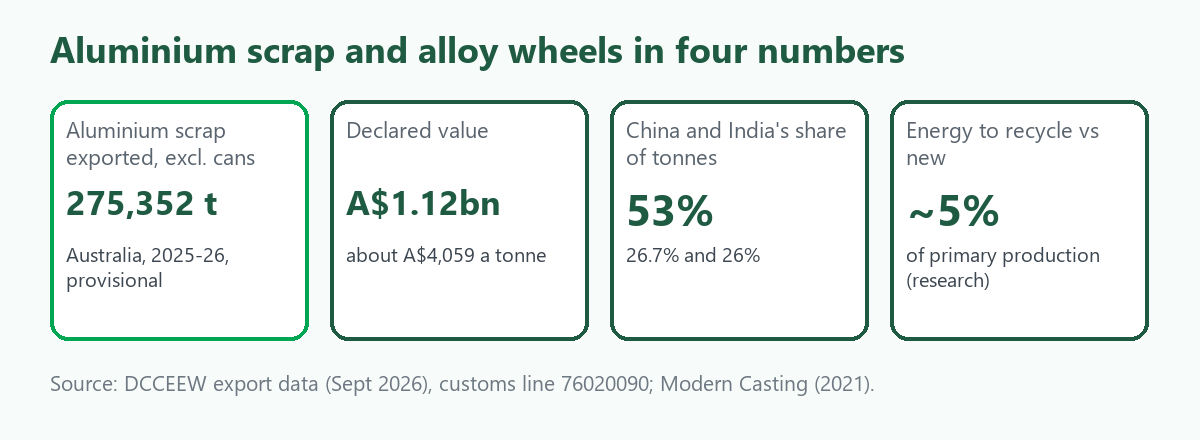
Once graded, the wheels are loaded in bulk and sold to a trader, a melter or an exporter. In Australia, the government's export records have a customs line for aluminium waste and scrap other than beverage cans, which includes wheels, extrusions, castings, offcuts and more. In 2025-26 (provisional), Australia exported 275,352 tonnes under that line, with a declared value of A$1.12 billion, or about A$4,059 a tonne. That is a border declaration for a mixed class of scrap, not a price for wheels.
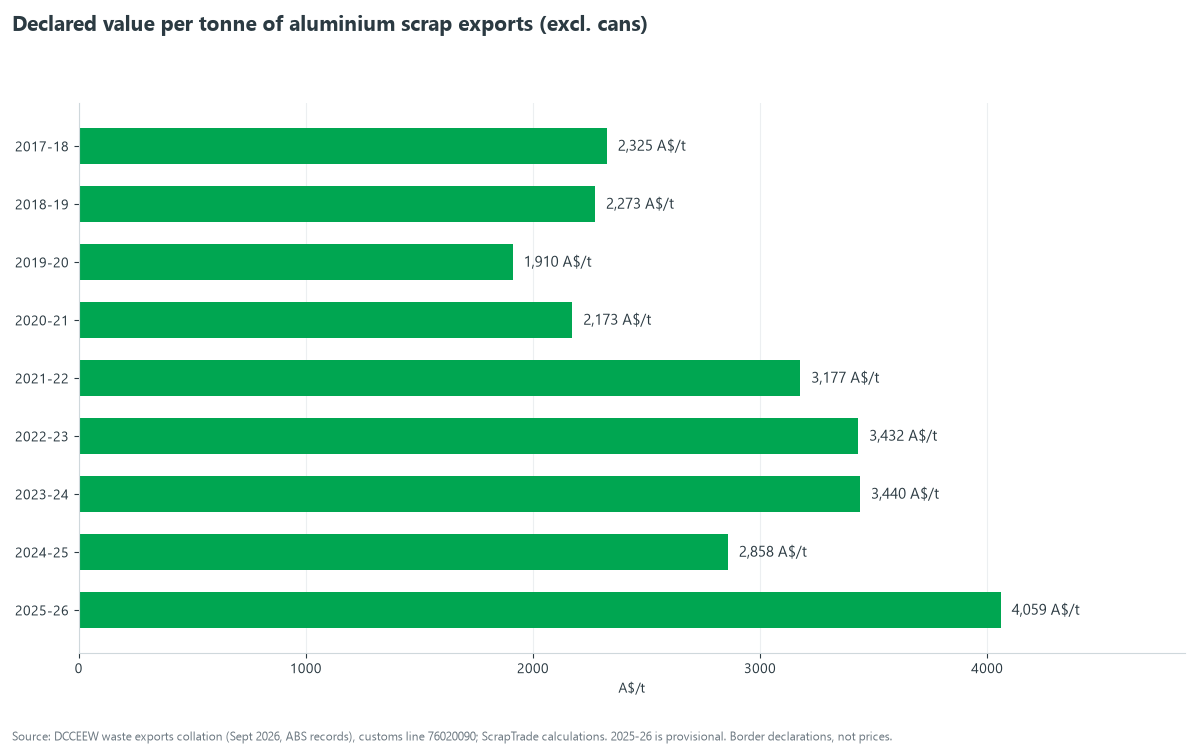
The declared value per tonne is up from A$2,858 in 2024-25 and A$2,325 in 2017-18, even though the tonnes fell about 22 percent in the latest year, from 351,759. That fits the metal price moving more than the volume, though we cannot prove the cause from these records.
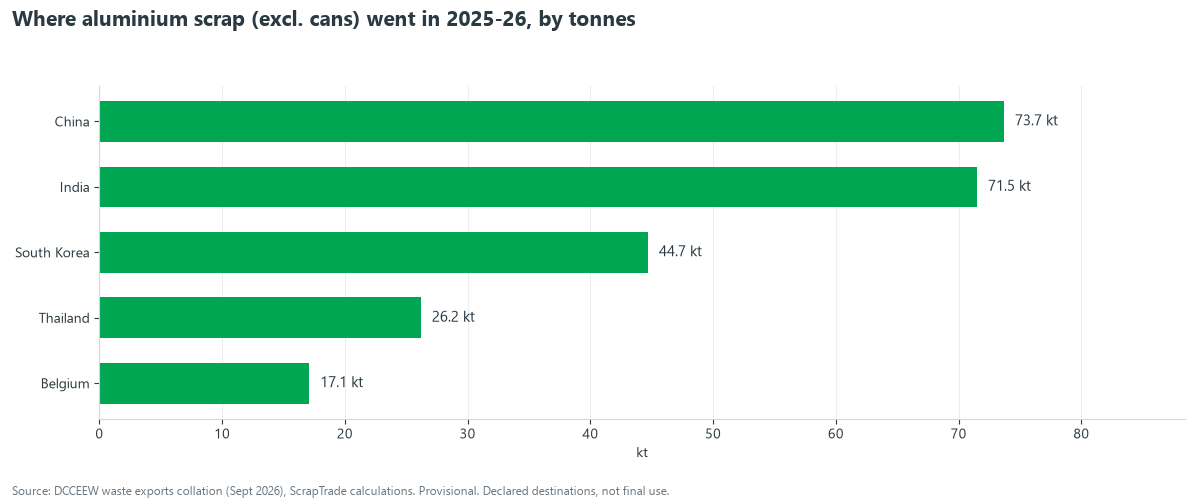
By tonnes, China took 26.7 percent, India 26 percent, South Korea 16.2 percent, Thailand 9.5 percent and Belgium 6.2 percent. Victoria supplied about 113,600 tonnes, Queensland about 60,900 and New South Wales about 56,400. For who buys it, see Who Buys Australian Aluminium and Copper Scrap. The records do not say which of these tonnes were wheels, so we cannot say where your wheel goes.
Step 5: A remelter turns it into casting ingot
At a remelter, wheel scrap is melted and cast into ingot for foundries. The most useful description we found comes from the casting industry. Wheels are generally cast from an alloy called A356, in which iron is kept very low: the A356.2 specification allows 0.12 percent iron at most and A356.1 allows 0.15 percent. A foundry paper in Modern Casting says A356.2 is normally not possible from 100 percent recycled metal, but that 0.15 percent iron allows significant recycled content.
Why does iron matter? Researchers at Ohio State University write that recycled aluminium-silicon-magnesium alloys can be weaker and less ductile than the new-metal versions because iron builds up when mixed scrap is recycled again and again. They developed an alloy to cope with extra iron, which shows how much of the effort in this field goes into controlling it.
So the remelter wants clean scrap. Paint and clearcoat are a problem in the melt, and "dirty scrap" is described in the same Modern Casting paper as a main cause of metal loss. A US company, Eccomelt, which makes alloy from post-consumer wheels, says its process produces a specification alloy from wheel scrap. That is a vendor claim.
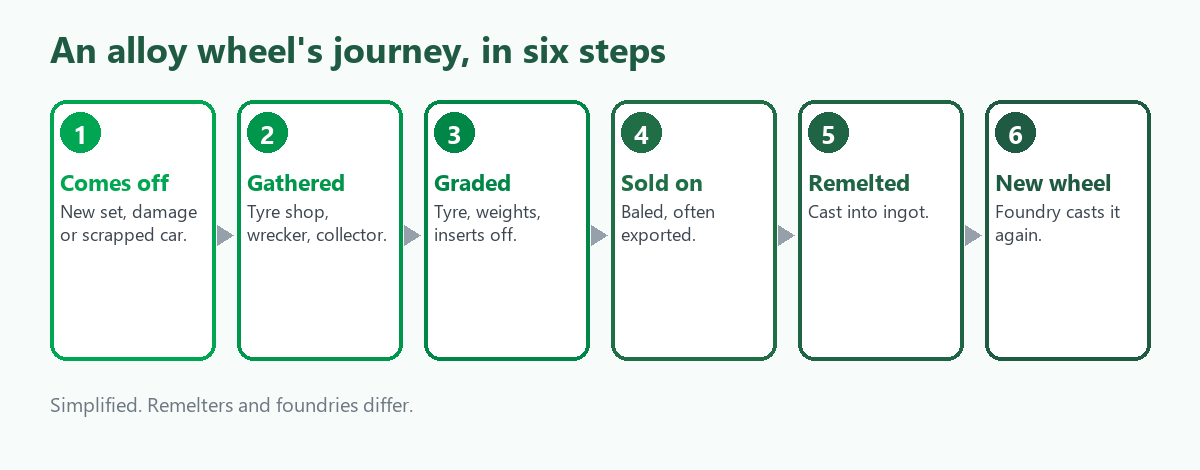
Step 6: A foundry casts new wheels
The ingot goes to a foundry that casts wheels, and the loop closes. The clearest example we found is in Germany. Ronal Group's R70-blue wheel uses 60 percent recycled aluminium, half from production scrap and half from post-consumer scrap, with the other 40 percent low-carbon primary aluminium, and the post-consumer scrap comes from Eccomelt. Ronal reports a 70 percent cut in carbon footprint against a standard wheel. Those are company figures, and we have not checked them independently.
We found no source confirming an Australian company that casts alloy wheels from recycled metal, so we cannot tell you that a wheel scrapped here comes back as a wheel here. A different loop does exist in Queensland for window frames and other extrusions. In July 2025, Capral, Sims Metal and Rio Tinto announced that Capral's scrap from its Bremer Park site would be sorted by Sims, remelted at Rio Tinto's Boyne Smelter in Gladstone, and returned to Capral as billet. The project targeted 1,000 tonnes with at least 20 percent recycled content. We did not check whether it has reached full production.
How much really comes back?
For wheels specifically, we found no national recycling rate. What the sources do agree on is the size of the prize: recycled aluminium uses about 5 percent of the energy of primary production, according to the Ohio State paper and the Modern Casting article. The Modern Casting paper gives a global average of 16.8 tonnes of CO2e per tonne of primary aluminium and 0.673 for recycled, cradle to gate, from the Aluminum Association. The same paper cites a European A356.1 alloy with 80 percent recycled content at 1.89 tonnes per tonne.
The catch is that, according to one research source we found, recycling wheels into lower-value products loses much of what makes them valuable, which is a controlled alloy. A wheel that is mixed into a heap of unsorted cast scrap can still be recycled, but it may not become a wheel again.
What this means for you
- If you are a driver: let the tyre shop keep the tyres, ask whether they will pay for the old wheels, and keep the wheel nuts and caps for yourself. A wheel kept clean is worth more than the same wheel with a tyre on.
- If you run a tyre shop or wrecker: take off the weights and valve stems, separate alloy from steel, and keep chrome apart from bare wheels if the buyer grades them separately. A tidy stack of clean wheels is the easiest aluminium to sell.
- If you collect or trade aluminium: ask how each buyer grades wheels, whether they want tyres on or off, and what they do with chrome. You can list your wheels on the ScrapTrade marketplace or create a free account.
For the brass and bronze journey, from the plumber to the furnace, see Where Old Brass and Bronze Go After You Sell It.
What we could not verify
- Where your own wheel goes. Buyers sell to different remelters and exporters.
- How many wheels are in the export figures. The customs line includes every kind of aluminium scrap except cans.
- Whether any Australian company casts wheels from recycled metal.
- An Australian recycling rate for wheels. We found none.
- The grade names and chrome discount. They come from a secondary scrap guide, not an official specification.
- The recycled-content and carbon claims for Eccomelt and Ronal. They are company figures.
- The current status of the Capral, Sims and Rio Tinto project.
- What yards pay today.
Frequently asked questions
Are alloy wheels worth more than steel wheels as scrap?
Yes. Aluminium is worth far more per kilogram than steel, and clean cast wheels are usually among the better-paid aluminium grades.
Should I take the tyre off before selling?
Buyers generally pay for the metal, so a clean wheel is worth more. Tyre removal needs suitable equipment and training, so most people leave it to a tyre shop.
Are alloy wheels recycled into new wheels?
Sometimes. Some wheel makers overseas use recycled wheel scrap, but we found no Australian maker doing so.
Does chrome or paint matter?
Buyers can pay slightly less for chrome-plated wheels, and paint and clearcoat are a nuisance in the melt. Do not strip finishes with unsuitable chemicals.
Sources
- Department of Climate Change, Energy, the Environment and Water, Waste exports data collation, September 2026 (ABS records), ScrapTrade calculations, customs line 76020090 (aluminium waste and scrap, excluding beverage cans). The 2025-26 figures are provisional.
- M. Hartlieb and G. Wittbecker, "Minimizing the Carbon Footprint of A356 Castings", Modern Casting, 11 August 2021.
- Cinkilic, Moodispaw, Zhang, Miao and Luo, "A New Recycled Al-Si-Mg Alloy for Sustainable Structural Die Casting Applications", Ohio State University.
- Light Metal Age, Ronal Group's R70-blue recycled aluminium wheel (28 November 2022, as dated on the page).
- Capral, Sims Metal and Rio Tinto, closed loop aluminium recycling in Queensland, Aluminium Council news item, 10 July 2025.
- Published patent description, "Method for recycling aluminum alloy wheels" (US 7,086,618), as summarised in search results, for the list of wheel contaminants.
- Scrap grade and price guide, "aluminum wheel scrap prices" (secondary source), for the clean wheel description and chrome note.
This is general information, not financial or legal advice. Process steps are simplified, and plants differ. Declared export values are border declarations, not prices. ScrapTrade operates a scrap marketplace and has a commercial interest in the scrap trade.