

Updated 26 October 2026. Few scrap markets are as openly contested as Vietnam's. It imports a large share of its ferrous scrap, its mills buy from a handful of origins at once, and a few dollars a tonne can move a cargo from one country to another. For Australian sellers it is one of the most important destinations for ferrous scrap. This profile looks at who supplies Vietnam, what changed in 2025 and 2026 and where Australia sits. It builds on ScrapTrade's earlier look at the market, Vietnam's Scrap Market, EAF Steel Growth and Import Trends, and adds the latest customs data. It is general information, not trading advice.
The size of the market
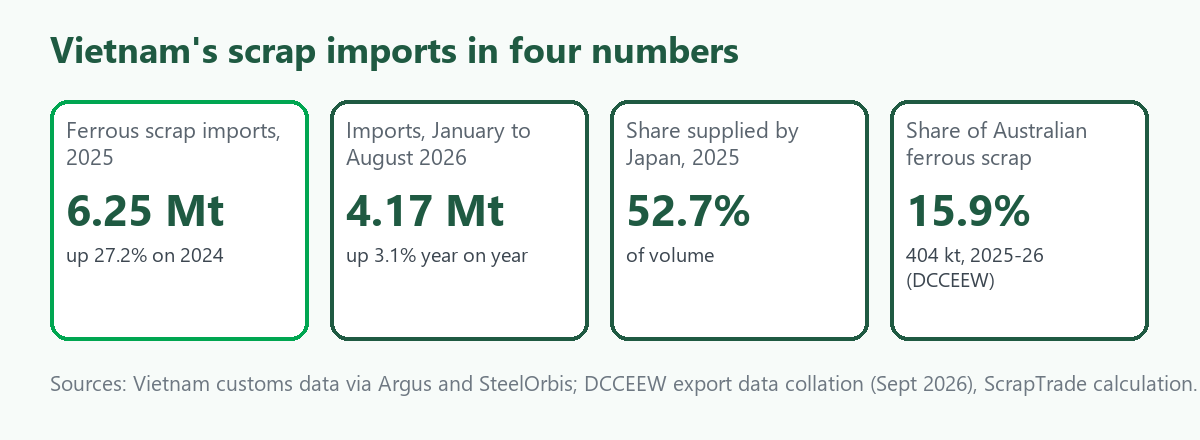
Argus, using Vietnamese customs data, reports that Vietnam imported 6,254,456 tonnes of ferrous scrap in 2025, up 27.2% on 2024 [1]. In January to August 2026 imports were 4.17 million tonnes, up 3.1% on the same months of 2025, according to SteelOrbis [2]. So growth has slowed sharply: 2025 was a surge, 2026 is a plateau.
Who supplies Vietnam
| Origin, 2025 | Tonnes | Notes |
|---|---|---|
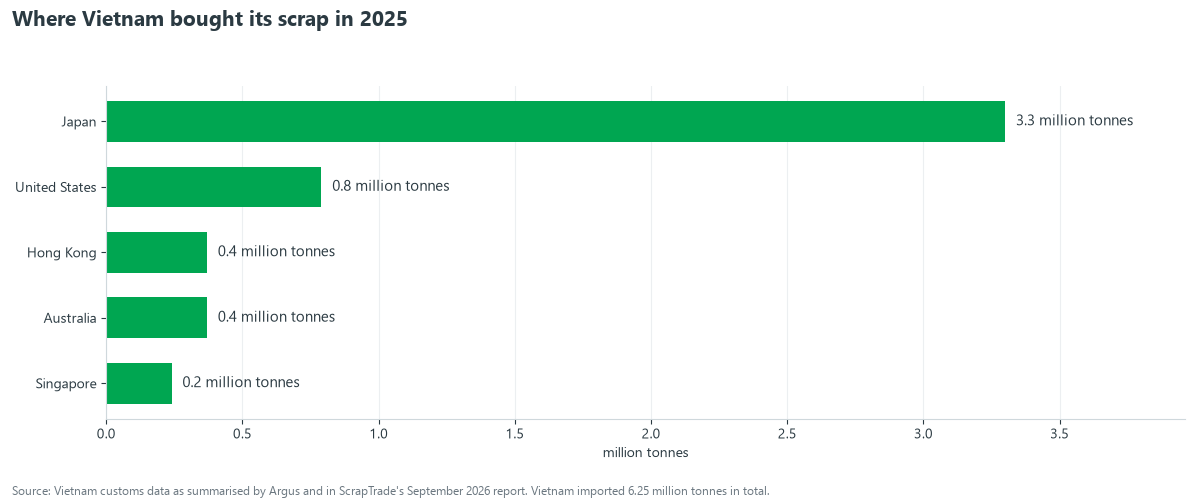
| Japan | 3,295,631 | 52.7% of the total, up about 26% |
| United States | about 788,000 | up 56% |
| Hong Kong | about 370,000 | the only major supplier to fall |
| Australia | 369,525 | up 8.8% |
| Singapore | about 239,000 | roughly tripled |
Source: Argus and SteelOrbis, from Vietnamese customs data [1][3]. The 52.7% share is our calculation from Argus's table.
Three things stand out. Japan is more than half of the market. The United States returned in force, despite its own domestic pull. And Singapore, a trading hub rather than a producer, tripled its volumes, which shows how much Vietnamese buying is routed through traders.
What changed in 2026
Japan's shipments to Vietnam have fallen. Vietnamese customs data show Japanese supply of 1,781,364 tonnes in January to August 2026, down 16.9%, while Japanese data show 1.82 million tonnes, down 15.8% [3][4]. See our Japan profile for the supply side. With total imports up 3.1%, others must have filled the gap, though the data we have do not show by whom.
On price, SMM reported in June 2026 that Australian offers were around US$380 to 385 a tonne CFR Vietnam, while Japanese H2 scrap traded at around US$370 [5]. For comparison, in February 2025 Japanese H2 bulk offers were US$315 to 320 [6]. These are spot quotes from trade reports, not averages, and they move weekly.
Where Australia fits
Australia sent about 369,525 tonnes to Vietnam in 2025 by Vietnamese customs count, up 8.8% [3]. Australian export records for the 2025-26 financial year show 404,000 tonnes, or 15.9% of our ferrous scrap exports, going to Vietnam [7]. The two figures cover different periods and are counted at different ends of the shipment, so they should not be compared directly.
The pattern is clear. Vietnam is a major market for Australia, but not the largest: Bangladesh is. See Bangladesh: Australia's Top Scrap Customer and Australia's Scrap Metal Exports: 2025-26 Data.
Why Vietnam imports so much
Many Vietnamese mills melt scrap in electric arc furnaces and rely on imports to run, as our earlier article explains. That is why the market is price-sensitive and trade-led: buyers can switch origin quickly, and traders buy from several countries and resell. Our earlier article covers the steel side in more detail.
What it means for Australian sellers
- Compare against Japan, every time. Japanese offers set the reference. If your CFR price is above it, the buyer needs a reason.
- Freight is part of the offer. Australia is farther than Japan, so quality, grade consistency and loading speed have to make up the difference. See the real cost of sourcing scrap abroad.
- Traders matter. The jump in Singapore volumes shows that many cargoes pass through hubs. Be clear who the end buyer is and what they will accept.
- A plateau is not a collapse. Volumes are steady and the supplier mix is changing, which is when new origins can win share.
- Document the load. See How a Scrap Export Deal Works, Step by Step for the checks that protect a deal.
Compare offers on the marketplace and see World Scrap Trade: Top Importers and Exporters for the larger map.
What to watch
| Signpost | Why it matters |
|---|---|
| Japanese shipments to Vietnam | Shows whether the largest supplier keeps losing share |
| US and Singapore volumes | The fastest-growing origins in 2025 |
| Australian monthly shipments | Shows whether our share rises as Japan slows |
| H2 CFR price gap, Japan versus Australia | Decides which cargo wins |
Frequently asked questions
How much scrap does Vietnam import?
6.25 million tonnes of ferrous scrap in 2025, up 27.2%, according to Argus [1].
Who supplies Vietnam?
Japan (52.7%), the United States, Hong Kong, Australia and Singapore [1][3].
Are Vietnam's imports still growing?
Only slowly: up 3.1% in January to August 2026 [2].
What does Vietnam pay for scrap?
Recent spot quotes were around US$370 to 385 a tonne CFR in June 2026, but they change weekly [5].
Where does Australia rank?
Roughly level with Hong Kong, at about 370,000 tonnes in 2025 by Vietnamese customs data, behind Japan and the United States [1][3].
Sources
- Argus, Vietnam's ferrous scrap imports rise in 2025 (13 January 2026).
- SteelOrbis, Vietnam scrap import reports for January to August 2026, as cited in Japan's steel scrap exports down 9.5 percent in January-August 2026.
- SteelOrbis, Vietnamese customs data tables for 2025 and 2026, as reported.
- SteelOrbis, as in source 2, for Japanese-side data.
- SMM, Vietnam import scrap remains soft as buyers stay cautious (June 2026).
- Argus and trade reports of February 2025 offers; figures are spot quotes.
- Department of Climate Change, Energy, the Environment and Water, Waste exports data collation, September 2026 (ABS records), ScrapTrade calculations.
Figures are as reported by the sources named. Prices are spot quotes and change weekly. This article is general information, not financial or trading advice. ScrapTrade operates a scrap marketplace and has a commercial interest in the scrap trade.