

Updated 27 October 2026. Ask most scrap traders which Asian markets matter most to Australia and you hear Bangladesh, India and Vietnam. The national export records tell a different story for ferrous scrap. In 2025-26 Indonesia was Australia's second-largest buyer, at about 506,000 tonnes, ahead of Vietnam and India, and its purchases rose by half in a year. Yet Indonesia gets far less trade-press coverage than its neighbours, which also means less published market data. This profile sets out what the Australian records show, what we can say about Indonesian demand and the rules, and where we have to say we do not know. It is general information, not trading or customs advice.
What Australia sells Indonesia
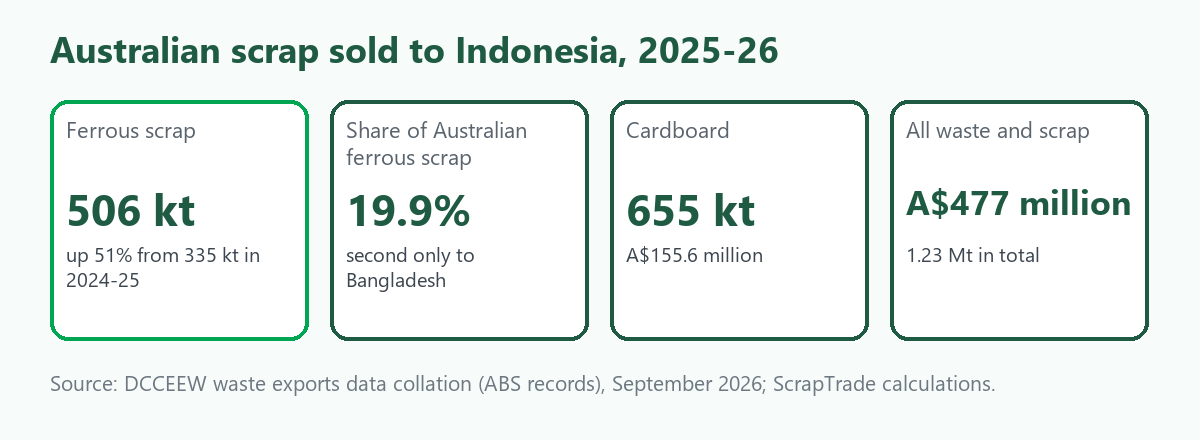
Australian export records (DCCEEW's collation of ABS data, our calculations) show 1.23 million tonnes of waste and scrap went to Indonesia in 2025-26, worth A$477 million, up from 1.0 million tonnes and A$438 million in 2024-25 [1].
- Ferrous scrap: 505,919 tonnes worth A$256.8 million, up 51% from 335,050 tonnes. That is 19.9% of Australia's 2.55 million tonnes of ferrous scrap exports, behind only Bangladesh [1].
- Cardboard: 654,839 tonnes worth A$155.6 million, the second-largest line and a reminder that Indonesia's paper mills import heavily too [1].
- Aluminium: 13,040 tonnes worth A$49 million, down sharply from 54,295 tonnes in 2024-25 [1].
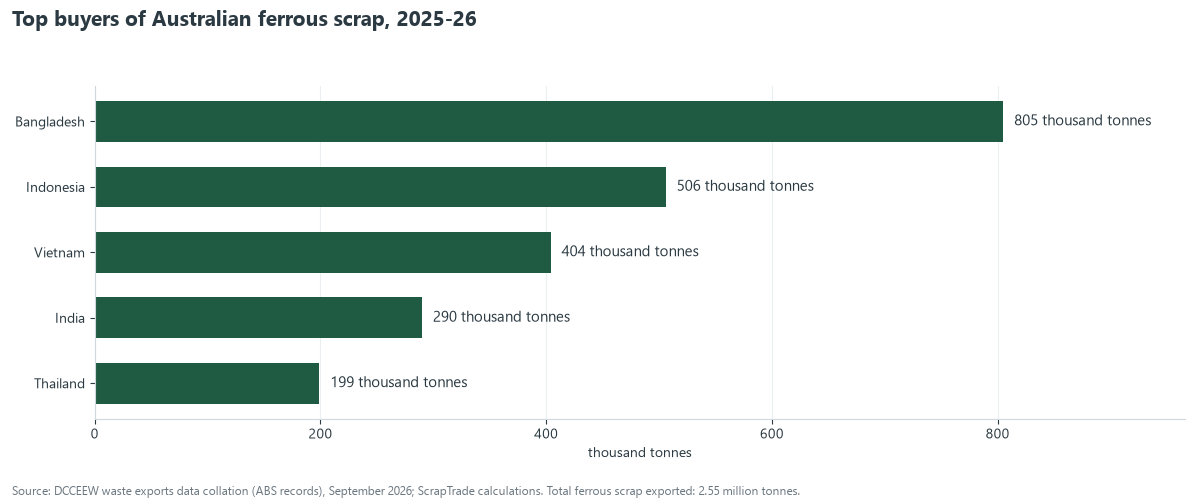
The ferrous rank moved a long way in a year. In 2024-25 Indonesia was fourth, behind Bangladesh, India and Vietnam, with 335,050 tonnes. In 2025-26 it overtook both India (290,192 tonnes) and Vietnam (404,146 tonnes) [1]. For the other buyers see Bangladesh: Australia's Top Scrap Customer, Vietnam Scrap Imports: Suppliers and Outlook and India's Scrap Market.
Most of the tonnage is ordinary ferrous scrap. About 383,000 tonnes was the main grade category (steel scrap excluding cast iron and alloys), 93,000 tonnes was ferrous scrap and remelting ingots, and 27,000 tonnes cast iron [1].
Why Indonesia buys
Indonesia's steel industry relies on scrap, and domestic collection is not enough. Skylight Strategic estimates that its arc furnace production requires around 8 million tonnes of scrap a year and that local collection falls short [2]. SMM reports that billet is the dominant import category, reflecting limited domestic scrap feedstock and construction demand [3]. Sims, in a report to the Bureau of International Recycling, described demand across Thailand, Vietnam, Indonesia and Malaysia as relatively stable going into 2026 [4]. These are consultancy and trade estimates, not official statistics, so treat the 8 million tonne figure as an order of magnitude.
We could not find a published 2025 or 2026 total for Indonesia's ferrous scrap imports from the paid trade reports, so we cannot tell you Australia's share of Indonesian imports. That is a gap, not an omission of something we know.
The rules: older sources, check before you ship
Indonesia's scrap import rules have changed several times, and the sources we could verify are not recent.
- 2019 tightening. Indonesia classed ferrous, aluminium and copper scrap as waste, required licences and permits from several ministries and direct shipments from the country of origin, and declared a temporary moratorium in November 2019. Pre-shipment inspection was tied to a 0.5% waste threshold [5][6].
- 2020 easing. The industry minister said steel mills were running at about 40% capacity partly because the rules for ferrous scrap were too strict, and reports said relaxation could allow up to 5 million tonnes of imports [7].
- Current position. The International Energy Agency's policy database, last updated in June 2024, says non-hazardous metal scrap is among exemptions from import prohibitions, with import licensing applying [8].
We could not identify the regulation currently in force by number or date. Before shipping, confirm with your buyer, who will hold the import approval, which version applies and what inspection is required. Pre-shipment checks can decide whether a cargo is accepted. See How a Scrap Export Deal Works, Step by Step.
What it means for Australian sellers
- Indonesia now matters as much as the big three. A 51% rise in one year makes it a market worth direct relationships, not just trader offers.
- Concentration is a risk. A market that grew this fast can also fall fast. A rule change in 2019 stopped trade for weeks. Do not rely on a single buyer.
- Paper and metal go together. Many Australian exporters that sell cardboard to Indonesia also ship metals, which can help build relationships.
- Document grade and cleanliness. Rules have focused on waste contamination, so clean, well-described loads matter.
- Compare against other Asian bids. See Japan Scrap Exports for the main competing supplier and World Scrap Trade: Top Importers and Exporters for the wider map.
You can check an indicative price on the price calculator and compare offers on the marketplace. See also Australia's Scrap Metal Exports: 2025-26 Data.
What to watch
| Signpost | Why it matters |
|---|---|
| Indonesian import licensing or inspection changes | The 2019 episode shows how fast flows can stop |
| Indonesia's steel capacity additions | Drive scrap demand |
| Australian monthly shipments | Show whether the 51% rise holds |
| Chinese steel exports to Indonesia | A competing source of finished steel |
Frequently asked questions
How much Australian scrap goes to Indonesia?
506,000 tonnes of ferrous scrap in 2025-26, 19.9% of the total, plus 655,000 tonnes of cardboard [1].
Where does Indonesia rank among Australian buyers?
Second for ferrous scrap by tonnes, behind Bangladesh [1].
Why does Indonesia import scrap?
Its arc furnace industry needs more scrap than it can collect locally [2].
What are the import rules?
They have changed since 2019. Non-hazardous metal scrap is reported exempt from import bans with licensing applying. Confirm the current rules with your buyer [8].
Do we know Indonesia's total scrap imports?
Not from sources we could verify.
Sources
- Department of Climate Change, Energy, the Environment and Water, Waste exports data collation, September 2026 (ABS records), ScrapTrade calculations. See Australia's Scrap Metal Exports: 2025-26 Data.
- Skylight Strategic, Insight report of steel industry in Indonesia 2026.
- SMM, Indonesia steel market 2026: capacity growth and Chinese import surge.
- Recycling Today, Steel output surges while scrap prices languish (May 2026), reporting the Sims comments to BIR.
- Argus, Indonesia suspends scrap imports amid new policy (2019).
- Waste360, Indonesia finalizes scrap import regulations (2019).
- Waste360, Indonesia to relax scrap metal import rules (2020).
- International Energy Agency, Import policies and conditions (Indonesia) (updated June 2024).
Figures are as reported by the sources named. Rules change and the sources on Indonesian rules are not recent, so verify before shipping. This article is general information, not legal, customs or trading advice. ScrapTrade operates a scrap marketplace and has a commercial interest in the scrap trade.