

Updated 27 October 2026. Malaysia is a market where the paperwork and the purity of the load matter as much as the price. Over five years it has built one of the strictest scrap import regimes in Asia: a certificate before declaration, a minimum purity, a radiation limit and, since 2024, a wider list of metals covered. Australian sales to Malaysia have fallen as these rules, and other factors, have taken hold. This profile sets out the rules as reported, what the Australian export records show and what we cannot confirm. It is general information, not legal or customs advice, and anyone shipping to Malaysia should check the current requirements with the buyer and the regulator.
Most of the detail below comes from a single SMM analysis, and we did not review the legal texts themselves. We flag where that matters.
The rules, as reported
According to SMM, the regime was built in steps [1]:
- March 2021. A 15% export duty on ferrous scrap (HS 7204). This is an export rule, not an import rule, but it shaped enforcement.
- January 2022. The first import inspection rules. SIRIM was named as the inspection and certificate body. Shredded material under 5 mm was banned and a radiation cap of background plus 0.25 microsieverts per hour was set.
- April 2023. The Customs (Prohibition of Imports) Order 2023 required a certificate of approval (COA) before an import declaration, with SIRIM as the sole permit issuing agency.
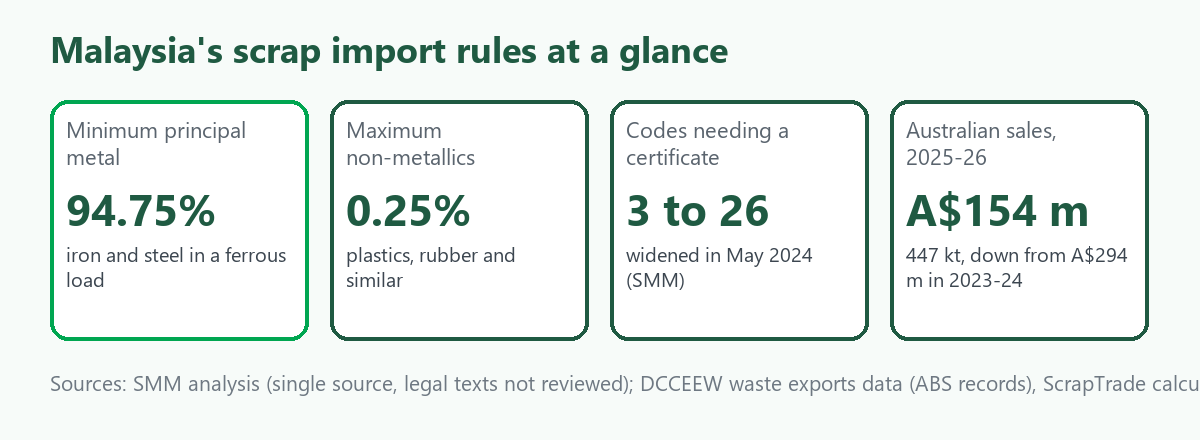
- May 2024. COA coverage was widened from three HS codes (ferrous 7204, copper 7404 and aluminium 7602) to 26, adding nickel, lead, zinc and tin scrap, and document and cargo checks were tightened.
Purity and inspection thresholds. A load must contain at least 94.75% of the principal metal, other metals are capped at 5% and non-metallics such as plastics at 0.25%. Fines and shreds under 5 mm are barred. Hazardous items, including oils, paints, asbestos, sealed containers, medical waste, radioactive material and munitions, can lead to the whole cargo being seized. Inspection can take place before shipment at origin or on arrival [1].
Enforcement
SMM describes a "zero tolerance" stance. An anti-corruption operation, "Op Metal", led by the Malaysian Anti-Corruption Commission since mid-2024, has targeted schemes that misdeclared ferrous scrap, for example as machinery, to avoid the 15% export duty, and joint and random port inspections have increased. Authorities say more than RM 950 million in revenue was lost over six years, and RM 332 million of assets have been frozen or seized [1]. Those figures are attributed to the authorities, and we could not verify them.
Who bears the cost
SMM reports that small and mid-sized traders carry most of the burden through inspection fees, bank guarantees and delays, and that a failed check can mean a returned cargo and, for some, insolvency. Many have left the business or changed lines. Mills and smelters report cleaner feedstock and fewer contaminants. Traders also argue that geology and handheld meters can push a clean cargo over the radiation limit [1]. These are the author's reports and the traders' claims, not findings we have tested.
SMM links the new regime to a fall in import value after 2022, but this is the author's interpretation and not a demonstrated cause [1].
What Australian records show
Australian export records (DCCEEW's collation of ABS data, our calculations) show Malaysia taking 447,298 tonnes of waste and scrap worth A$153.7 million in 2025-26, down from 546,455 tonnes and A$294.1 million in 2023-24 [2].
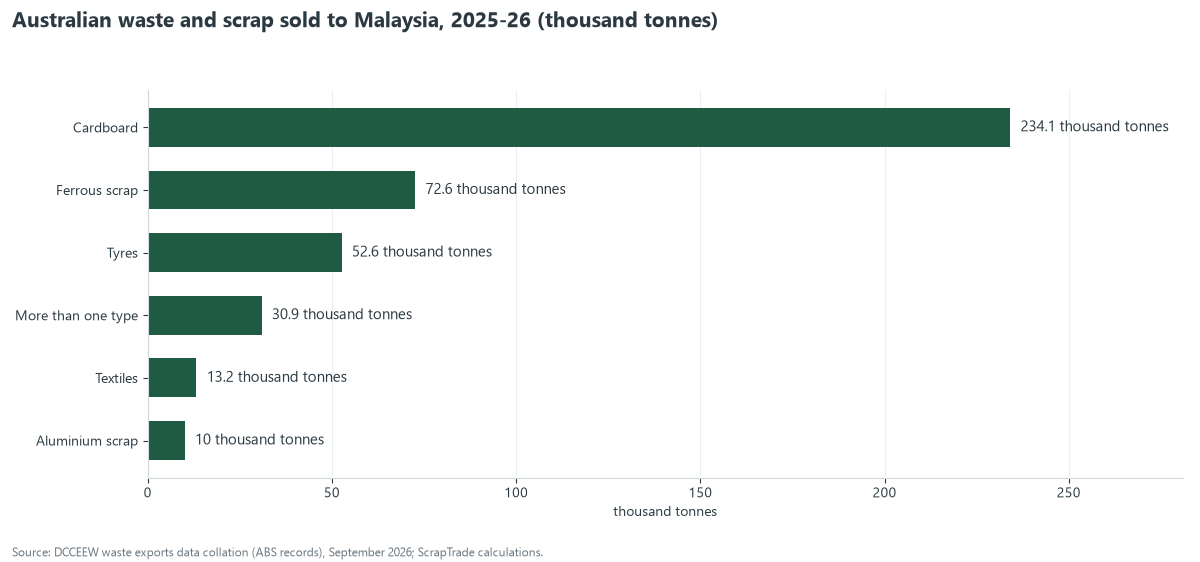
- Cardboard is the biggest line by tonnes, at 234,127.
- Ferrous scrap was 72,584 tonnes worth A$37.9 million, about 2.8% of Australia's ferrous exports. It was 154,603 tonnes in 2023-24, so it has more than halved in two years.
- Aluminium scrap fell from 41,926 tonnes (A$82.6 million) in 2023-24 to 9,968 tonnes (A$34.2 million).
- Tyres were 52,643 tonnes, and textiles and mixed material make up most of the rest.
The fall in metal volumes is clear, but we cannot say how much of it is due to Malaysia's rules. Aluminium and ferrous scrap have also faced weaker demand and competing buyers elsewhere. The honest reading is that Malaysia is now a small buyer of Australian metal scrap and a demanding one.
The EU draft list
Reports based on the Recycling International coverage of the European Commission's draft list say Malaysia and Thailand would not be authorised to receive EU metal scrap [3]. This is a draft, it is not adopted and it governs EU exports, not Australian ones. See EU Scrap Exports: Volumes, Rules and Duties for the broader picture.
What it means for Australian sellers
- Treat the certificate as part of the product. The buyer or their agent normally arranges the COA, but a cargo that fails inspection becomes a dispute. Agree in the contract who bears the cost of rejection and return.
- Purity is a spec, not a hope. A 94.75% minimum and a 0.25% cap on non-metallics mean sorted, clean loads. See how to grade scrap metal.
- Keep fines out and keep contamination out. Anything under 5 mm is barred, and sealed containers, oils and batteries can lead to seizure of the entire cargo.
- Check radiation before loading. The limit is close to background. See How a Scrap Export Deal Works, Step by Step.
- Use verified counterparties. Our trust and safety page explains how ScrapTrade checks them.
- Do not build your plan on Malaysia. Bigger markets are Bangladesh, Indonesia and Vietnam. For Thailand's separate proposal see Thailand's Scrap Import Ban Proposal Explained.
For the full numbers see Australia's Scrap Metal Exports: 2025-26 Data. Compare offers on the marketplace.
What we could not confirm
- Current rules. We found no recent primary source from Malaysia's trade ministry or customs on 2026 changes. The detail is as reported by SMM, whose publication date we could not independently confirm.
- Malaysia's total scrap imports. We did not find current ferrous import volumes by origin, so we cannot give Australia's share of Malaysian imports.
- The cause of Australia's decline. We cannot separate the effect of the rules from demand and competition.
Frequently asked questions
Do I need a certificate to ship scrap to Malaysia?
Malaysia requires a certificate of approval before import, issued through SIRIM, for ferrous, copper, aluminium and, since 2024, other listed metals [1]. Your buyer usually arranges it.
What purity does Malaysia require?
At least 94.75% of the principal metal and no more than 0.25% non-metallics in ferrous loads [1].
Are shredded fines allowed?
Material under 5 mm is barred [1].
How much scrap does Australia sell Malaysia?
447,298 tonnes of all waste and scrap in 2025-26, including 72,584 tonnes of ferrous scrap [2].
Is Malaysia a good market for Australian metal scrap?
It is a small and demanding one at present.
Sources
- SMM, Malaysia's scrap metal trade enters an age of austerity. The page shows a September 2025 publication date. Legal texts were not reviewed.
- Department of Climate Change, Energy, the Environment and Water, Waste exports data collation, September 2026 (ABS records), ScrapTrade calculations.
- IndexBox, EU waste shipment regulation: India, Malaysia, Thailand excluded from metal scrap imports under draft list, citing Recycling International. The exclusion is mentioned in one line without detail.
Figures are as reported by the sources named. Rules change and the main source is a single analysis, so verify before shipping. This article is general information, not legal, customs or trading advice. ScrapTrade operates a scrap marketplace and has a commercial interest in the scrap trade.