

Updated 27 October 2026. Taiwan used to be a dependable outlet for Australian steel scrap. In 2022-23 it took about 230,000 tonnes of Australian ferrous scrap. In 2025-26 it took about 90,000. The drop is not an Australian problem alone: Taiwan's mills have been cutting imports for three years as steel demand weakens, and the cargoes they still buy increasingly come in containers from the United States and the Dominican Republic. This profile sets out the numbers from Taiwanese customs data, what has happened to prices, what Australian export records show and one place where the sources contradict each other. It is general information, not trading advice.
The decline in numbers
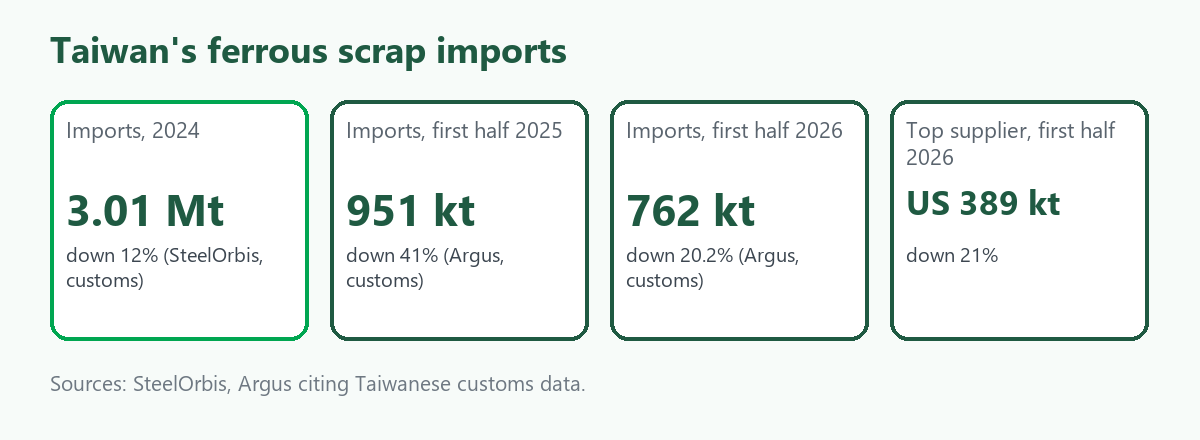
Taiwanese customs data, reported by SteelOrbis and Argus, give a clear trend [1][2][3]:
- 2024: 3,008,037 tonnes of ferrous scrap imported, down 12% on 2023 [1].
- First half of 2025: about 951,000 tonnes, down 41% on the first half of 2024. Argus attributed it to lower steel output and mills leaning more on imported billet and domestic scrap [2].
- First half of 2026: 762,031 tonnes, down 20.2% on a year earlier, even though June rose to 158,704 tonnes after mills restocked [3].
Semi-finished steel imports fell in line, to 1.35 million tonnes in the first half of 2026, down 22%. Argus ties both declines to weak steel demand in Taiwan [3]. Taiwan's mills also cut buying during the summer electricity restriction period, and Argus expected imports to edge lower from July [3].
Who supplies Taiwan
| Origin, first half 2026 | Tonnes | Change on a year earlier |
|---|---|---|
| United States | 388,591 | down 21% |
| Dominican Republic | 46,920 | up 44.3% |
| Japan | 46,446 | down 10.4% |
| Australia | 79,261 | see the note below |
| Others | 200,813 | up 42.9% |
Source: Argus, 28 July 2026, citing Taiwanese customs data [3].
The United States remains the top supplier, although its volume fell. Argus says supply from the Dominican Republic and other South American countries rose strongly and filled the gap left by Japan [3]. Japan's own customs data show the same retreat from the other side: its exports to Taiwan in January and February 2026 were 21,247 tonnes, down 73.3%, and Argus said Taiwanese mills continued to favour more competitively priced containerised scrap [4]. See Japan Scrap Exports: Buyers, Rules, Outlook.
Prices
Taiwan buys on price, and the price picture in 2026 has been unusual. SteelOrbis reported on 27 March that import scrap quotations had risen to a 20-month high, that offers for containerised US heavy melting scrap had moved from US$340 to about US$345 to 347 a tonne CFR and that Japanese H1/H2 offers had disappeared, leaving only higher-priced HS grade at US$388 to 393 [5]. A leading mill, Feng Hsin, had raised its delivered procurement price for local scrap to TWD 10,000 a tonne, about US$313, and a source at a major producer said the gap between local and import scrap prices remained large [5]. Argus's containerised HMS 1/2 80:20 assessment rose by US$64 to US$361 on 19 May, then prices fell from late May [3].
These are spot quotes and move weekly. The point for a seller is that Taiwanese mills compare imported cost against cheap local scrap and against imported billet, so a rise in import prices pushes them to buy less.
What Australian records show
The national export records (DCCEEW's collation of ABS data, our calculations) show the trend from the Australian side [6].
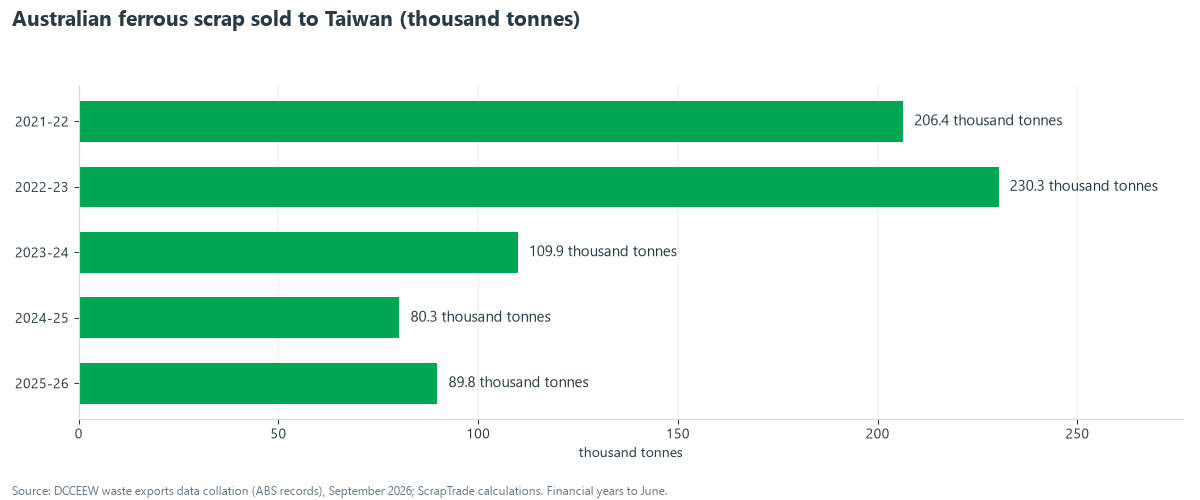
Taiwan took 247,500 tonnes of Australian waste and scrap in 2022-23, falling to 120,341 in 2023-24, 87,076 in 2024-25 and 92,150 in 2025-26 (A$82 million). Ferrous scrap is almost all of it: 89,774 tonnes in 2025-26 worth A$66.5 million, about 3.5% of Australia's ferrous exports [6]. Other lines are small: aluminium 1,487 tonnes and other non-ferrous metals 560 tonnes. Compare Australia's big ferrous buyers in Indonesia: Australia's No. 2 Scrap Buyer and Vietnam Scrap Imports.
Where the data clash
The Argus table gives Australian-origin ferrous scrap at 79,261 tonnes in the first half of 2026. As we read it, the table shows that as a fall of 66.7% on a year earlier [3]. Australian records say something different. They show 56,424 tonnes of ferrous scrap shipped to Taiwan from January to June 2026, against 34,001 tonnes in the same months of 2025, a rise of about 66% [6]. The two sources differ on level (79,000 against 56,000 tonnes) and, as we read them, on direction.
We cannot resolve this from the information we have. The percentage may have been recorded with the wrong sign, the two series may count different shipments (by loading date in Australia, by arrival or customs entry in Taiwan, or by origin where cargo transits another port), or we may have misread the table. Because of this we do not say whether Australian volumes to Taiwan rose or fell in 2026. If it matters to a deal, check Taiwanese customs data directly.
What it means for Australian sellers
- Plan for a smaller Taiwan. Whatever the 2026 direction, volumes are far below 2022-23, and the buyers' main reasons, weak steel demand and cheaper local and billet alternatives, are not going away quickly.
- Containers beat bulk here. Taiwanese mills have favoured containerised scrap, which suits smaller lots and quick restocking. A seller who cannot fill a vessel can still compete.
- Price discipline matters. Mills buy when import prices look cheap against local scrap and stop when they do not. Know the gap before quoting.
- Competition is changing. The Dominican Republic and other South American origins are gaining. See World Scrap Trade: Top Importers and Exporters.
- Have alternatives. Bangladesh, Indonesia, Vietnam and Thailand take far more. See Bangladesh: Australia's Top Scrap Customer and Thailand's Scrap Import Ban Proposal Explained.
For the full Australian picture, see Australia's Scrap Metal Exports: 2025-26 Data. Compare offers on the marketplace.
What to watch
| Signpost | Why it matters |
|---|---|
| Taiwanese steel output | The root cause of weak scrap demand |
| Import versus local scrap price gap | Decides when mills buy |
| Containerised HMS price | The main reference for Taiwan |
| Customs data on Australian-origin scrap | Would settle the direction question above |
Frequently asked questions
How much scrap does Taiwan import?
762,031 tonnes of ferrous scrap in the first half of 2026, down 20.2%, after 3.01 million tonnes in 2024 [1][3].
Who supplies Taiwan?
The United States is the top supplier, followed by the Dominican Republic, Japan and Australia, among others [3].
Why are imports falling?
Weak steel demand, a reliance on imported billet and cheaper local scrap, and seasonal electricity restrictions [2][3].
How much does Australia sell Taiwan?
About 89,774 tonnes of ferrous scrap in 2025-26, down from 230,260 tonnes in 2022-23 [6].
Is Taiwan a good market for Australian steel scrap?
It is a shrinking one. Containerised lots can still compete, but larger markets exist.
Sources
- SteelOrbis, Taiwan's scrap imports down 12 percent in 2024.
- Argus, Taiwan's scrap imports plunge in Jan-Jun (2025).
- Argus, Taiwan's scrap imports drop in January-June (28 July 2026).
- Argus, Japan's scrap exports fall in February (31 March 2026).
- SteelOrbis, Taiwanese mills struggle to secure local and import scrap, prices rise further (27 March 2026).
- Department of Climate Change, Energy, the Environment and Water, Waste exports data collation, September 2026 (ABS records), ScrapTrade calculations.
Figures are as reported by the sources named. Where sources conflict we say so. This article is general information, not financial or trading advice. ScrapTrade operates a scrap marketplace and has a commercial interest in the scrap trade.