

People ask the same things about scrap again and again: what it is worth, who buys it, how a deal works, whether the business pays. This page answers 34 of them in one place, grouped under five headings: scrap metal and prices, scrap trade and exports, scrap deals, the scrap industry and the scrap business. Each answer is short and links to a longer article where one exists. It is general information, not legal, tax or trading advice.
How we chose the questions
We looked at the questions Google suggests as people type five phrases ("scrap metal", "scrap trade", "scrap deal", "scrap industry" and "scrap business") with the location set to Australia. We dropped the ones about video games (several "scrap" questions are about game items), questions about places we do not cover and ones too local to answer, then grouped the rest. This is a count of recurring questions, not a ranking by search volume. The search tool we used gives volumes for only some phrases and they were too small and patchy to rank by, so we do not claim an order of popularity.
Every number below is dated and sourced. Where we do not have a verified answer, we say so.
Scrap metal and prices
How much is scrap metal worth?
It depends on the metal, the grade, the form, the quantity, where you are and the day. As a guide, ScrapTrade's price index listed clean heavy melting steel (HMS 1) at A$0.3985 a kilogram on 26 October 2026, copper bare bright wire at A$11.67 and aluminium extrusion at about A$2.63. ScrapTrade says these are AI-generated indicative estimates refreshed daily, not quotes, and that real yard prices vary by location, grade and condition [7]. Ring two buyers before you sell. See How to Get the Best Scrap Metal Prices.
How much is a tonne of scrap metal worth?
For a sense of scale, Australian exporters declared ferrous scrap at about A$600 a tonne, aluminium at about A$3,790 and copper and copper-alloy scrap at about A$10,800 a tonne in 2025-26 [1]. Those are border values for large mixed shipments, not what a collector or small yard is paid.
What scrap metal is worth the most?
Precious-metal scrap is worth far more per tonne than base metals, and among common metals copper is worth far more than aluminium and steel. In 2025-26 Australia exported 2,238 tonnes of precious-metal scrap worth A$371 million [1]. Catalytic converters are one source, and their value depends on an assay, not weight. See Catalytic Converter Scrap: Value, Theft and Exports.
Are scrap metal prices going up or down?
We do not forecast prices. Our market articles describe what has moved prices and what could move them, for copper and aluminium. One thing is worth knowing: Australian scrap export volumes are seasonal, with January usually the weakest month, but that data shows tonnes, not prices. See Australia's Scrap Exports by Month.
What is the difference between ferrous and non-ferrous scrap?
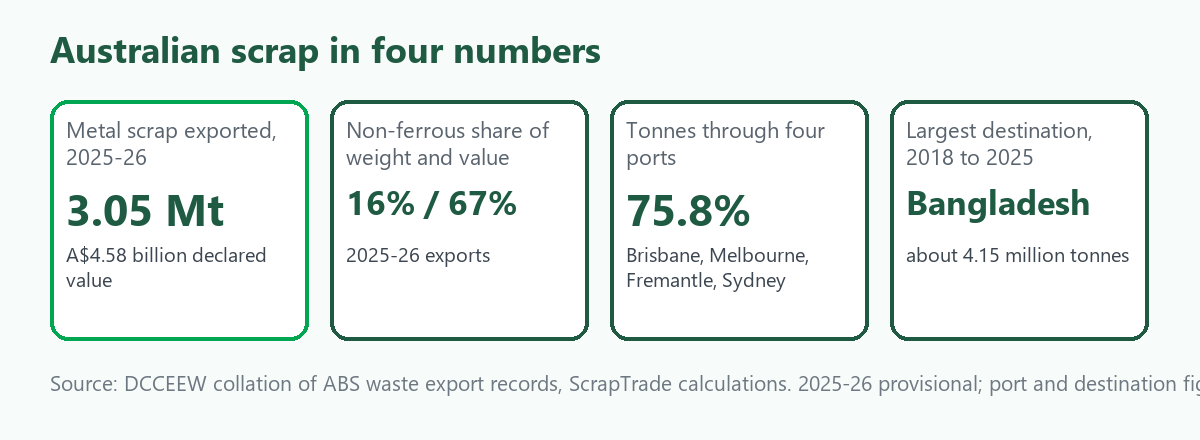
Ferrous scrap is iron and steel, and non-ferrous scrap is metal without iron as its base, such as aluminium, copper, brass, zinc and nickel. In Australia's 2025-26 exports, non-ferrous metals were about 16% of the weight but 67% of the value [1].
What do grade names like HMS 1 and Copper 1 mean?
A grade describes the type and cleanliness of the scrap. On ScrapTrade's index, HMS 1 is clean heavy melting steel, Copper 1 is clean tubing, bus bar and wire at least 1/16 inch thick, and Copper 2 has some solder, paint or light oxidation [7]. Grade differences are real money: on the index, moving a tonne from Copper 2 to Copper 1 is worth about A$1,139. See Copper Scrap: Grades, Prices and Demand.
Where can I see current scrap prices?
ScrapTrade publishes an indicative price index and a calculator that converts material, grade and weight into a value in 20 currencies [7]. For how the benchmarks used in the trade are built, see How Scrap Prices Are Set.
Scrap trade and exports
What is scrap trading?
Scrap trading is buying and selling scrap material for resale, whether from a collector to a yard, from a yard to a processor or mill, or from an exporter to an overseas buyer. A trader makes money on the difference between buying and selling prices, less handling, freight and risk. Our walk-through is How a Scrap Export Deal Works, Step by Step.
What happens to scrap metal in Australia?
A large share is exported. Australia shipped 3.05 million tonnes of metal scrap worth A$4.58 billion overseas in 2025-26 [1]. We do not have a verified figure in this data for how much stays and is melted at home, so we cannot give a split.
Who buys Australian scrap metal?
By tonnes, the four largest destinations from 2018 to 2025 were Bangladesh, India, Indonesia and Vietnam [1]. Buyers differ by metal: India, South Korea and China lead for aluminium, and China leads for copper. See Who Buys Australian Aluminium and Copper Scrap and Bangladesh vs Indonesia vs Vietnam.
How do I export scrap metal from Australia?
In outline: find a buyer, agree grade, weight method and price, choose a delivery term, arrange the shipment and documents, and agree how you will be paid. On the legal side, Australia's export licence regime covers glass, plastic, tyres and paper and cardboard, hazardous waste needs a permit, and e-waste is presumed hazardous. We could not find an Australian government statement that clean ferrous or non-ferrous scrap needs no export permit, so check with the regulator. See Australia's Waste Export Rules and Scrap Metal.
How is scrap metal shipped overseas?
By sea, either as bulk cargo or in containers. Four ports (Brisbane, Melbourne, Fremantle and Sydney) carried 75.8% of the tonnes in 2025-26, excluding precious-metal scrap [1]. See Australia's Scrap Export Ports.
What do FOB, CFR and CIF mean in scrap deals?
They are Incoterms, shorthand for where the seller's job ends, who pays the freight and who carries the risk. A price quoted CFR includes sea freight and one quoted FOB does not, so compare prices on the same basis. See Incoterms in Scrap Deals.
Which countries import the most scrap?
Our articles describe Turkey as the world's biggest scrap importer, and cover India, Bangladesh, Pakistan, Vietnam and others as major buyers. See Turkey: World's Biggest Scrap Importer and World Scrap Trade: Top Importers and Exporters.
Can a country ban scrap imports or exports?
Yes, and several have restricted them. Our article Scrap Export Bans: Three Case Studies looks at how bans played out.
Scrap deals
How does a scrap deal work?
A typical deal runs in six steps: agree what is being sold (material and grade), how it will be weighed, the price and its basis, how and when it will be paid, how it will be checked at handover, and how it will be delivered. Disputes usually come from the vague ones, grade and weight. See How to Negotiate a Scrap Deal.
How do I avoid scrap scams?
Check who you are dealing with through a second route, never pay in full in advance to a stranger and confirm bank detail changes by phone. In Australia, payment redirection scams, where a genuine supplier's bank details are swapped on an invoice, cost A$166.8 million in 2025, the second-largest scam type by reported loss [5]. See How to Secure Scrap Deals and Avoid Scams.
How do I check that a scrap buyer or seller is genuine?
Check the company exists, find a phone number yourself and call it, ask for references and be wary of prices far below the market. See How to Verify Scrap Before You Buy or Sell.
How are international scrap deals paid?
The standard methods are cash in advance, a letter of credit, a documentary collection, open account and consignment, and each puts the risk on a different side [6]. A letter of credit pays only if documents match its terms exactly. See Getting Paid in International Scrap Deals.
Can I be paid cash for scrap metal?
Not from a dealer in New South Wales or Victoria, where cash payments for scrap are banned [2][3]. Queensland and Western Australia are unconfirmed and South Australia's planned ban was not yet in operation when we last checked. See Scrap Business Rules in Australia by State.
Do I need ID to sell scrap metal?
Usually yes when selling to a dealer. NSW dealers must keep a record of the seller's details, Victorian dealers must record the seller's name, address and identification details, and Queensland licensed dealers must sight and record identification [2][3][4].
How do I know how much a load weighs, and in what units?
Agree who weighs, on which scale and what tolerance applies. Beware of units: a tonne, a gross ton and a short ton are different weights. See Tonnes, Gross Tons and Short Tons in Scrap.
What if the buyer says the grade is lower than agreed?
Write the grade standard and the checking method into the deal beforehand, keep photos and weighbridge tickets from loading and consider an independent inspection for larger or distant loads. No payment method settles a grade dispute for you.
What is escrow in a scrap deal?
Escrow holds the buyer's money with a third party until delivery is confirmed. ScrapTrade says it collects a 5% buyer deposit once an offer is accepted or an auction closes and releases it to the seller when the buyer confirms the load matches the listing or when 24 hours pass with no dispute. That protects the payment step, not the condition of the material. See ScrapTrade's trust and safety page.
The scrap industry
How big is the scrap metal industry?
For Australia, the export side was 3.05 million tonnes and A$4.58 billion in 2025-26 [1]. We do not quote a global figure here. For world flows see World Scrap Trade: Top Importers and Exporters.
Who represents the scrap recycling industry?
Several bodies, including the Bureau of International Recycling (BIR), the US-based ReMA, the British Metals Recycling Association and the Waste Management and Resource Recovery Association in Australia. See Who Speaks for Scrap Recycling.
Is scrap metal export growing?
From 2020-21 to 2025-26, Australian metal scrap export tonnes rose 24.8% and declared value rose 86.7%, with precious-metal scrap excluded [1]. See Australian Scrap Exports: Seven Years of Change.
Can other countries' rules affect Australian scrap sellers?
Yes. Import duties, bans and quality rules in buyer countries change what Australian exporters can sell and where. See our country guides for India, China and Pakistan.
The scrap business
How do I start a scrap business in Australia?
Choose a model (agent, collector, broker or yard), register as a business, check your state's rules for buying from the public, set up a payment and record-keeping routine, and line up buyers before you buy stock. See How to Start a Scrap Business in Australia.
Do I need a licence to buy scrap metal?
In NSW a scrap business must be registered with NSW Police, at A$260 every three years. In Victoria you must be a registered second-hand dealer. Queensland licenses second-hand dealers and has passed new scrap reforms, and WA and SA are unclear or pending [2][3][4]. Ask your regulator, and see our state-by-state guide.
How much money do I need to start?
It depends on the model. An agent working for a commission needs very little and holds no stock, a collector needs gear and a way to carry material, a broker needs working capital and a yard needs a site, equipment and approvals. We have no verified dollar figure for any of them, so we do not give one.
Is the scrap business profitable?
It can be, but we have no verified industry-wide profit figure and will not invent one. What the data shows is where value sits: non-ferrous scrap carried 67% of export value on 16% of the weight [1], and grading and sorting move the price. Margins depend on what you pay, what you sell for, your costs and the risk you carry.
Which scrap business is the most profitable?
We cannot say from the evidence we have. Higher-value metals such as copper carry more money per tonne, but customs data shows neither costs nor margins. Test a small model before you commit.
Can I run a scrap business from home?
An agent or broker model needs no yard, so much of it can be run from anywhere. Storing or processing scrap at a home address may need approval from your council and state environmental regulator, and we did not verify the thresholds. Ask them before you start.
Questions we left out
We skipped questions where we could not give a verified answer: where scrap metal can be dropped off free in a particular suburb, how to dispose of old appliances and whether specific items such as fridges are accepted. These depend on your council and the yard, so ring them. We also left out questions about other countries' scrap businesses, such as India or the UAE. Our coverage is Australian.
What this means for you
- Get two quotes before selling anything of value.
- Know your grade, because it moves the price more than most things you can control.
- Know your state's rules on registration, cash and records before you buy from the public.
- Write grade, weight and payment into every deal.
- Verify before you pay, and confirm bank details by phone.
You can see current indicative prices, compare buyers on the marketplace, or register.
Sources
- Department of Climate Change, Energy, the Environment and Water, Waste exports data collation, September 2026 (ABS records), ScrapTrade calculations. 2025-26 figures are provisional.
- NSW Police Force, Scrap Metal Industry.
- Consumer Affairs Victoria, Scrap metal laws.
- Queensland Government, Legal requirements for second-hand dealers and pawnbrokers.
- National Anti-Scam Centre, Continued action critical to combat fraud as annual scam losses exceed $2 billion (30 March 2026).
- US International Trade Administration, Trade Finance Guide, Methods of Payment.
- ScrapTrade, Price Index (indicative, AI-generated estimates, accessed 26 October 2026).
Prices and figures are dated and are not quotes or forecasts. State rules change, so verify with your regulator. This article is general information, not legal, tax or trading advice. ScrapTrade operates a scrap marketplace and has a commercial interest in the scrap trade.